


Mark Damsgaard
Founder of Global Residence Index
Last updated: November 12, 2026

Mark Damsgaard
Founder of Global Residence Index
Last updated: November 12, 2026
Turkey’s citizenship by investment program allows eligible foreign investors to apply for Turkish nationality through a qualifying property investment of at least US$400,000, with a commitment not to sell for three years. Other routes include specified investments starting at US$500,000 or the creation of at least 50 jobs.
A qualifying investment can support applications for the investor, their spouse, and eligible children. Successful applicants become Turkish citizens and can apply for Turkish identity cards and passports.
The program does not require the years of residence associated with ordinary naturalisation. However, investment certification, residence-permit procedures, identity checks, and government approval are still required. Meeting the investment threshold does not guarantee citizenship.
For a broader comparison, explore our guide to citizenship by investment programs.
| Feature | Current position |
|---|---|
| Minimum property investment | US$400,000 in qualifying real estate |
| Main financial alternatives | US$500,000 in qualifying deposits, securities, funds, pension contributions, or fixed capital |
| Employment route | Creation of at least 50 jobs, certified by the relevant ministry |
| Property holding requirement | Three-year restriction recorded at the land registry |
| Family inclusion | Spouse and eligible minor or dependent children |
| Residence requirement | No minimum period of living in Turkey for the investment route; an investor residence permit forms part of the process |
| Language requirement | No Turkish-language test under this exceptional citizenship route |
| Dual citizenship | Permitted by Turkey, subject to the applicant’s other nationality laws |
| Final approval | Citizenship is granted by Presidential decision following government review |
Speak with one of our experts today
Applicants must be able to make a qualifying investment, establish their identity and family relationships, and satisfy the authorities’ national-security and public-order checks. Banks and other institutions also assess the source of funds and conduct their own compliance checks.
Eligibility should be reviewed before paying a property deposit or transferring investment funds. Nationality can affect the ability to acquire particular property, and bank acceptance is a separate issue from citizenship eligibility.
The investment route provides for:
Parents, siblings, and financially independent adult children are not covered by the standard family provisions. Each included person must satisfy the applicable requirements, and family documentation must establish the relationship, custody, and parental consent where relevant.
The qualifying investment threshold does not increase simply because an eligible spouse or child is included. Document, application, identity-card, and passport costs can increase with family size.
Do not assume a child’s age is frozen when the application is submitted. Turkey’s citizenship authority states that children who reach adulthood before their parents’ citizenship process finishes cannot continue on the same basis as minor children. Families with a child approaching 18 should obtain advice on timing and any separate basis for eligibility before committing funds.
The following are qualifying investment thresholds, not complete application budgets.
| Investment route | Minimum requirement | Main condition |
|---|---|---|
| Real estate | US$400,000 | Qualifying property with a three-year restriction on sale |
| Bank deposit | US$500,000 or equivalent foreign currency | Qualifying deposit maintained for three years under the prescribed conversion and blocking rules |
| Government debt instruments | US$500,000 or equivalent foreign currency | Qualifying government securities held for three years |
| Real estate investment funds | US$500,000 or equivalent foreign currency | Qualifying fund units held for at least three years |
| Venture capital investment funds | US$500,000 or equivalent foreign currency | Qualifying fund units held for at least three years |
| Private pension system | US$500,000 or equivalent foreign currency | Contribution to designated funds, remaining in the system for at least three years |
| Fixed capital investment | US$500,000 or equivalent foreign currency | Investment certified by the Ministry of Industry and Technology |
| Job creation | At least 50 jobs | Employment certified by the Ministry of Labour and Social Security |
The fixed-capital and employment routes have their own certification and monitoring requirements. They should not be treated as interchangeable with a three-year bank deposit.
The US-dollar thresholds do not mean that every investment can remain in a US-dollar account.
For the bank-deposit route, the prescribed process involves selling the qualifying foreign currency through a Turkish bank to the Central Bank. The resulting Turkish-lira amount must remain in a qualifying lira deposit for three years. Government-debt and pension investments also have specific currency and holding rules.
Before choosing a route, obtain written confirmation of the currency, permitted investments, withdrawal restrictions, charges, and any interest or distribution arrangements. Exchange-rate movements, market performance, and the financial strength of the institution or issuer can affect the amount ultimately recovered.
Speak with one of our experts today
The property must meet the citizenship rules as well as the rules governing foreign ownership.
Eligible categories include properties with condominium ownership, registered construction servitude, or qualifying land classified as a building plot with a structure on it. Vacant land should not be treated as a qualifying citizenship investment. Buying a fractional share in a jointly owned property also does not qualify under the standard property route.
The review should cover the title, seller, ownership history, permitted use, construction status, mortgages, and other restrictions. A property’s advertised price or a developer’s citizenship claim is not proof of eligibility.
A property already used for another investor’s citizenship application cannot simply be reused for a new applicant. Related-party transactions and certain foreign ownership histories can also make a purchase ineligible.
The current process uses the TTB, an official document confirming the property investment amount accepted for citizenship purposes, subject to specified exemptions and alternative procedures.
Following the September 2026 changes, eligible SPK-licensed valuation companies can prepare the underlying report through the designated land-registry system. The process is no longer restricted to GEDAŞ alone.
The declared sale price, documented payments, and accepted valuation must meet the applicable minimum. Confirm the report’s validity and the current electronic submission requirements before filing.
Arrange the valuation and eligibility review before making an unconditional commitment. Paying US$400,000 does not by itself establish that US$400,000 will be accepted for citizenship purposes.
The prescribed foreign-exchange process must be completed through a bank, with a Döviz Alım Belgesi, commonly called the DAB or foreign-exchange purchase certificate.
Citizenship transactions also require bank evidence of payment to the seller. Cash payments or an informal currency-exchange receipt do not replace the required documentation.
Property taxes, legal fees, commissions, and other transaction expenses should be budgeted separately from the qualifying investment.
Multiple qualifying purchases can be combined to reach the threshold, provided the ownership, payment, valuation, and restriction requirements are satisfied.
Notarised preliminary sale contracts follow different rules. The full qualifying amount must be covered within one qualifying contract, which may include several properties. Separate preliminary contracts cannot simply be added together to reach the minimum.
A preliminary sale contract does not itself transfer ownership. Its registration, advance payment, and restrictions require careful legal review.
For the property route, the restriction is tied to the commitment recorded at the land registry. It is not a fresh three-year period starting when a passport is issued. Confirm the recorded start and release dates for the particular investment.
After the required period, the owner can request removal of the restriction and arrange a compliant sale. However, resale to the previous owner or certain close relatives can trigger cancellation of the investment certificate even after the holding period.
Do not assume a developer buyback arrangement is compatible with the citizenship rules. Early disposal or a non-compliant transaction can jeopardise the application or citizenship already obtained.
US$400,000 is the minimum qualifying property investment, not the total cost of obtaining citizenship.
A property-route budget should also account for:
| Additional cost | What to allow for |
|---|---|
| Title-deed transfer fee | Generally 2% for the buyer and 2% for the seller, calculated on the applicable declared transaction value |
| VAT | May apply depending on the property and transaction; exemptions are conditional |
| Valuation and registration | Required assessment, land-registry service charges, and related administration |
| Legal and professional services | Property due diligence, contracts, investment certification, and application assistance |
| Documents | Translations, notarisation, apostilles or legalisation, and civil-status records |
| Banking | Transfers, currency conversion, and account-related charges |
| Residence and citizenship procedures | Applicable application, permit, and document fees |
| Identity cards and passports | Separate issuance charges for each applicant |
| Property ownership | Insurance, maintenance, service charges, and applicable annual taxes |
For illustration, on an accepted transaction value equivalent to US$400,000, a 2% buyer’s transfer fee is equivalent to US$8,000. If the commercial agreement makes the buyer responsible for both parties’ shares, the combined 4% is equivalent to US$16,000.
These examples exclude all other costs and any higher applicable fee base. Confirm who pays each charge in the purchase agreement.
Review nationality, family circumstances, source of funds, and objectives. For property, complete independent legal and financial checks before signing binding agreements.
Obtain the required Turkish tax identification details, arrange banking and compliance checks, and prepare the family documents. A properly drafted power of attorney can authorise a lawyer to handle specified transactions.
Follow the required payment, currency-conversion, ownership, and holding procedures. For property, this includes the appropriate land-registry entries.
The responsible authority confirms that the investment meets the relevant citizenship requirements. The authority depends on the selected route.
The process includes the short-term investor residence permit under Article 31(1)(j). Complete the required appointments and identity checks.
The nationality authorities review the application and conduct the required checks. Additional documents or explanations may be requested before the file reaches a decision.
Following approval and civil registration, apply for Turkish identity cards and passports. Continue complying with the investment restrictions until the applicable period has been completed.
Speak with one of our experts today
The exact checklist depends on nationality, family structure, and investment route. It commonly includes:
Foreign documents generally require Turkish translations and the appropriate apostille or legalisation. The correct method depends on the issuing country and document type.
There is no requirement to complete several years of residence or spend a minimum number of days each year in Turkey to qualify through the investment route.
However, no minimum residence requirement does not mean a fully remote process. Applicants must complete the relevant residence-permit, fingerprint, and identity-verification procedures. Where personal attendance is required, a lawyer cannot replace the applicant.
Confirm the appointments needed for the investor, spouse, and children before booking travel.
The process involves several stages, and there is no guaranteed passport-delivery date. Document preparation, investment completion, certification, residence procedures, security checks, and passport issuance all affect the timetable.
Ask for a current estimate based on recent comparable applications, with the starting point clearly defined. An estimate beginning with a complete citizenship filing is different from the total time beginning with property selection.
Turkish citizenship provides the right to live and work in Turkey and establish a long-term home there. Citizens can access education and healthcare under the applicable enrolment, insurance, contribution, and eligibility rules.
Turkey permits dual citizenship, although another country’s laws may affect whether an applicant can retain their existing nationality.
Ordinary Turkish passports can be issued for up to 10 years for adults and up to five years for children under 18. Passport renewal is separate from citizenship status.
Turkish passport holders can make qualifying short visits to destinations such as Japan and Singapore without obtaining a visa in advance, subject to passport and entry conditions.
However, an ordinary Turkish passport does not provide general visa-free visitor access to the Schengen area, the United Kingdom, or the United States. A Turkish passport also does not confer EU residence or employment rights.
Visa-free entry, visas on arrival, electronic travel authorisations, and electronic visas are different arrangements. Check the requirements for the specific destination, purpose, and passport before travelling.
Turkey is a U.S. E-2 treaty country. Turkish nationals may therefore qualify to apply for an E-2 visa to develop and direct a qualifying U.S. business, subject to the separate investment and immigration requirements.
A person who acquired the relevant nationality through financial investment and has not previously held E status must have been domiciled in that treaty country for at least three continuous years at some point before applying.
For someone relying on Turkish citizenship acquired through investment, this is a domicile requirement. Simply holding the passport for three years while continuing to live elsewhere does not satisfy it.
The Turkish investment does not replace the separate qualifying U.S. business investment. E-2 approval is not automatic, and E-2 status does not itself grant a green card.
Acquiring citizenship does not, by itself, settle every question about Turkish tax residence.
Tax residence can arise through domicile in Turkey or continuous presence exceeding six months in a calendar year, subject to exceptions and treaty rules. Residents are generally taxed on worldwide income; non-residents are generally taxed on Turkish-source income.
For property owners, rental income, annual property taxes, and taxation on disposal require separate consideration. Completing the three-year citizenship holding period does not automatically make a property sale tax-free. Gains on a privately held property sold within five years of acquisition can be taxable, subject to the applicable rules and exemptions.
Turkey also has inheritance and gift taxation. Non-resident citizenship should not be presented as a blanket exemption, particularly because nationality and the location of assets can affect liability.
A separate tax regime introduced in 2026 can exempt qualifying individuals’ foreign-source income from Turkish income tax for 20 years.
It applies to individuals becoming resident from January 1, 2026, who meet the requirements concerning the absence of Turkish domicile and tax liability during the previous three calendar years. Certain earlier liabilities arising only from rental income, investment income, or capital gains do not prevent eligibility.
Applicants must obtain the required exemption certificate from the tax office within the prescribed deadline, generally the end of the year in which they become resident. Those becoming resident in November or December have until the end of the following February.
This benefit depends on tax residence and separate eligibility conditions. Obtaining Turkish citizenship alone does not activate it. Turkish-source income remains subject to the normal rules. The legislation also provides a 1% inheritance-tax rate for qualifying inheritances from beneficiaries during the exemption period.
Military obligations can matter for male applicants and sons included in the application.
Under the rules for people acquiring Turkish nationality later in life, those aged 22 or older in the year of naturalisation are generally treated as having fulfilled military service. Younger applicants may have obligations, with exemptions or deferrals depending on their circumstances.
Families should review this before applying, especially where children may later live or study in Turkey.
Speak with one of our experts today
The main routes involve acquiring or maintaining an investment, rather than making a citizenship donation. However, fees and taxes are additional expenses, and there is no guarantee that an asset can later be sold for its purchase price or that its foreign-currency value will be preserved.
No. The property, seller, ownership history, accepted investment amount, payments, and registered restrictions must all satisfy the rules. Complete the eligibility review before committing funds.
An eligible spouse and qualifying children can apply under the main investor’s qualifying investment. Each person still requires the appropriate documentation and approval, with additional individual costs.
No. The three-year requirement concerns maintaining the qualifying investment. Citizenship can be granted before that period ends, following successful completion of the application process.
A compliant sale after the required holding period does not itself end citizenship. The restriction must be properly released, and the resale must comply with the program’s rules.
No. Turkish citizenship provides rights in Turkey. Residence, employment, and long-term study in EU countries remain subject to those countries’ immigration requirements.
Global Residence Index can help assess your family’s eligibility, compare investment routes, and coordinate the documentation and legal review needed for an application.
Contact our team for a personalised cost breakdown and guidance on the current requirements for your circumstances.
Let us help you
As a trusted golden visa & citizenship by investment agent, our team is equipped to assess the ideal options for your unique situation, facilitate your application process, and keep you in compliance every step of the way. Our personalized investment migration consulting is your one-stop shop for obtaining a second citizenship or new residency. Fill out our contact form to get started with a complimentary consultation today.
GET PERSONALIZED GUIDANCE
What to expect during your consultation?
We proudly offer free consultations to interested applicants.
Here is what you can expect from your free consultation with our advisory team:
By the end of the consultation, you will know if you’re eligible to apply so you don't spend time and money investigating yourself
We will answer any specific questions you have about the program and application process
Our advisory team will explain every step of the process in detail so you know what to expect
We’ll help you understand the best programs and options for your situation
Contact Us
We value your privacy. Any details you share will be handled with complete confidentiality. Fill out the form below to connect with our team of experts. We look forward to assisting you.

We look forward to assisting you.
We offer clarity and reliable advice across a wide range of investment opportunities and immigration programs. We provide complete, personalized support - from the moment you reach out to the day your new residency card or passport is in your hands.

Our global team of experts is ready to help you.
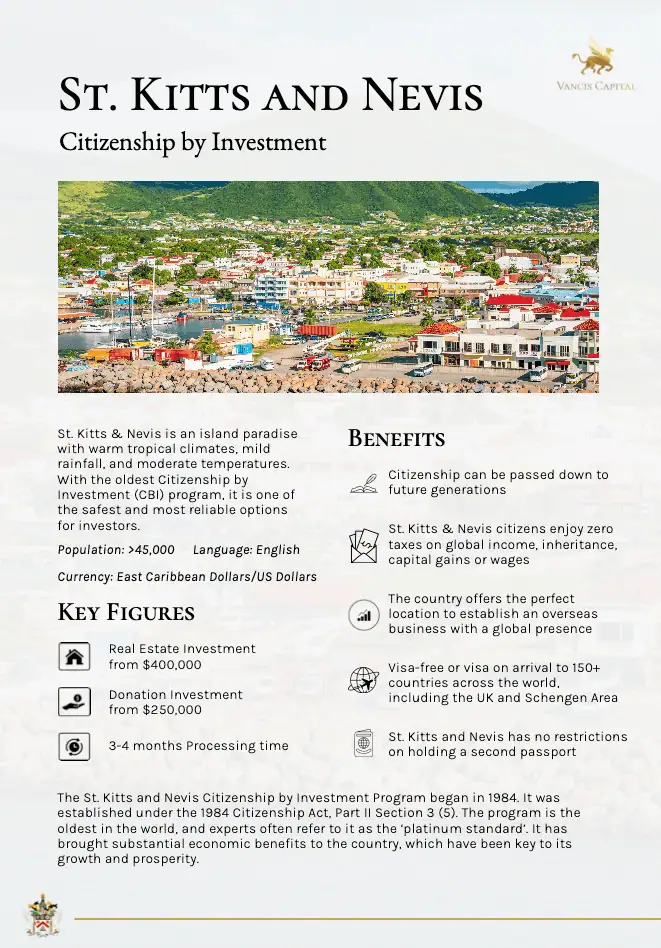
Get a step-by-step guide
to applying for Saint Kitts & Nevis Citizenship
We will help you apply with confidence, relying on our expertise and up-to-date market analytics.
Get a step-by-step guide
to applying for an Italian Golden Visa
We will help you invest with confidence, relying on our legal experience and up-to-date market analytics.